REGIONAL PERSPECTIVES


A Quarterly Publication of the North Central Florida Regional Planning Council

Spring 1998

LOCAL (DISASTER) MITIGATION STRATEGIES

The Florida Department of Community Affairs, Division of Emergency Management, is offering local governments in the north central Florida region funding to develop unified local mitigation strategies designed to reduce their vulnerability to natural disasters. Examples include the strengthening of existing structures and public facilities to withstand wind and other forces, elevating structures to reduce flood damage, implementing educational awareness programs for their citizens, and other related activities.

The benefits of developing and implementing a mitigation strategy include, but are not limited to, the saving of lives and property by reducing their vulnerability, reducing the amount of money spent on recovery and rebuilding by protecting important community assets, and receiving more post-disaster funding by pre-identifying mitigation projects.

THE ORIGINAL FLORIDA TOURISM TASK FORCE

REORGANIZATION

Initially appointed by the Planning Council in 1991 to study the region's potential for the developmnt of tourism as a form of local economic development, and later established as an on-going task force by Memorandums of Agreement between local economic development agencies and the Council, the Task Force is currently in the process of becoming a separate, 11-county interlocal agreement agency.
The Task Force is also currently negotiating with Visit Florida for The Original Florida region to become the eighth tourism district. This recently established public/private state agency utilizes districts to promote various areas of Florida. The state agency also collects and publishes statistics on tourists and tourism-related activities at the district level. The region is currently divided between two state tourism districts, one going east to Jacksonville, the other going west all the way to the Alabama state line.

(Continued on Page 3)

(Continued on Page 2)

REGIONAL PERSPECTIVES Spring 1998

NORTH CENTRAL FLORIDA POPULATION TRENDS

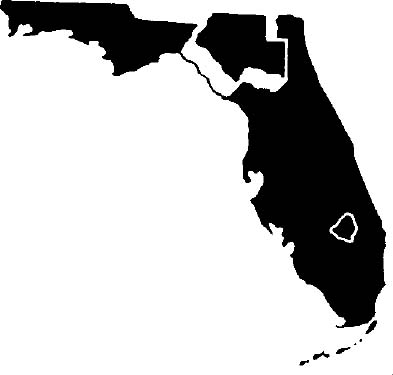
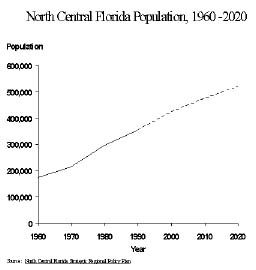
The eleven counties of north central Florida, The Original Florida, is projected to grow to over one-half million people by the Year 2020. As can be seen in the accompanying graph, population growth between 1960 and 1990 has held to a fairly steady rate—and this gentle rise is expected to continue well into the 21st Century.

Population growth so far has been led by the region's lone urban county, Alachua, which is projected to continue to comprise approximately one-half of the area's population in the Year 2020. Much of this increase can be attributed to the tremendous rise in student population shared by the University of Florida and Santa Fe Community College, and to the maturing of Gainesville as the regional market center.

Also fueling population growth is the steady influx of retirees—many of whom have relocated from other parts of Florida. The percent of total population of persons aged 65 and older is projected to increase from 8.3 percent in 1970 to 12.4 percent in the Year 2010.

An indicator of changing times for the north central Florida region can be noted from the fact that the ratio of natural increase (births over deaths) to net migration has reversed since 1970, i.e., during the decade between 1960 and 1970, the ratio was 56.9 percent natural increase to 43.1 percent net migration, as compared to the 1980-90 decade where the percentages have changed to 41.7 to 58.3 natural increase to net migration.

(The Original Florida Tourism Task Force Continued)

WEB PAGES OF INTEREST

North Central Florida Regional Planning Council
http://ncfrpc.org

The Original Florida http://originalflorida.org

North Central Florida Local Emergency Planning Committee http://www.afn.org/~lepc/

North Central Florida Areawide Development Co., Inc. http://adco.org

The establishment of an eighth district to include the region signals statewide recognition of Task Force efforts and accomplishments completed over a relatively short time period and with very moderate resources.


REGIONAL PERSPECTIVES Spring1998

(Local (Disaster) Mitigation Strategies Continued)

I-75 CORRIDOR COUNCIL
UPDATE

The I-75 Corridor Council has held two meetings since its inception was reported in the fall issue of the Regional Perspective. At its organization meeting held October 29 in Gainesville, the Council elected Alachua County Commissioner Penny Wheat as Chair and City of Lake City Commissioner Bettye Lane as Vice-Chair.

The Council also established a Technical Advisory Committee (TAC) whose recommendations to develop a master corridor plan and to proceed immediately with beautification projects at the Florida-Georgia state line, and the I-75 interchanges at I-10 (near Lake City) and S.R. 44. (Wildwood), were approved at the Council's January 21 meeting.

The Corridor Council agreed to meet quarterly. Its next meeting is scheduled for April 22 in Gainesville. For more information concerning the Corridor Council, contact Chuck Kiester at (352) 955-2200, extension 102, or e-mail kiester@ncfrpc.org

Cities and counties are encouraged to work together to develop a single, unified strategy by establishing a single working group composed of city and county representatives to oversee the development of a county-wide strategy. Funding is allocated to a county and to each city within that county based on their vulnerability to natural hazards. To ensure coordination among the cities and counties, however, a single contract is entered into between the state and a county, and the county must then enter into a subcontract with each of its cities.

Work must be completed within 18 months or by August 30, 1999, whichever date comes earlier. Similar to the development of county-wide emergency response plans and local government comprehensive plans, the Council is offering to assist its cities and counties with development of hazards mitigation strategies for the amount of funds allocated to each of the cities/counties within the region. For more information, contact Scott R. Koons, Director of Local Government Assistance, at (352) 955-2200, ext. 104.


REGIONAL PERSPECTIVES Spring 1998

ANNOUNCEMENTS

DISASTER AID AVAILABLE TO 10 OF THE 11 COUNTIES OF THE ORIGINAL FLORIDA REGION - Citizens residing in the counties of Alachua, Bradford, Columbia, Dixie, Gilchrist, Hamilton, Lafayette, Suwannee, Taylor, and Union in the north central Florida region are eligible for disaster assistance that helps individuals and families. Victims are encouraged to call FEMA's toll-free line 1-800-462-9029 (1-800-462-7585 for the hearing- and speech-impaired), even if they are in doubt of their eligibility.

Local governments in the counties of Bradford, Columbia, Gilchrist, Hamilton, Suwannee, and Union are eligible for assistance to help repair damaged infrastructure. Call 1-800-462-9029 for more information.

FLORIDA'S HIDDEN COAST FIRST ANNUAL BIRDFEST has been rescheduled to May 15 - 17 at Fanning Springs, Florida. For details or registration information, call W.D. Higginbotham at 352/955-2200, ext. 106, or visit The Original Florida home page at http://originalflorida.org.

North Central Florida
Regional Planning Council
2009 NW 67 Place, Suite A
Gainesville, FL 32653-1603

OFFICERS

Charles S. Chestnut, III
Chairman

D. Thomas Sawyer
Vice-Chairman

Dale McPherson
Secretary-Treasurer

Charles F. Justice
Executive Director

Charles L. Kiester
Assistant Executive Director
and Editor

Return to NCFRPC home page.